

Introduction
Turning a breakthrough idea into a working invention requires heavy investments of time, engineering, and capital. Without legal protection, competitors can analyze your finished product, copy its functionality, and sell it without bearing any of your research and development costs. A patent grants you the legal power to stop them.
What Is a Patent?
A patent is a property right granted by a government that gives an inventor the exclusive right to exclude others from making, using, offering for sale, selling, or importing the patented invention.
Patents operate on a grand bargain with the public: in exchange for revealing full technical details of your invention to the public, the government awards you a limited-time legal monopoly (typically 20 years from your initial filing date).
The Three Main Types of Patents
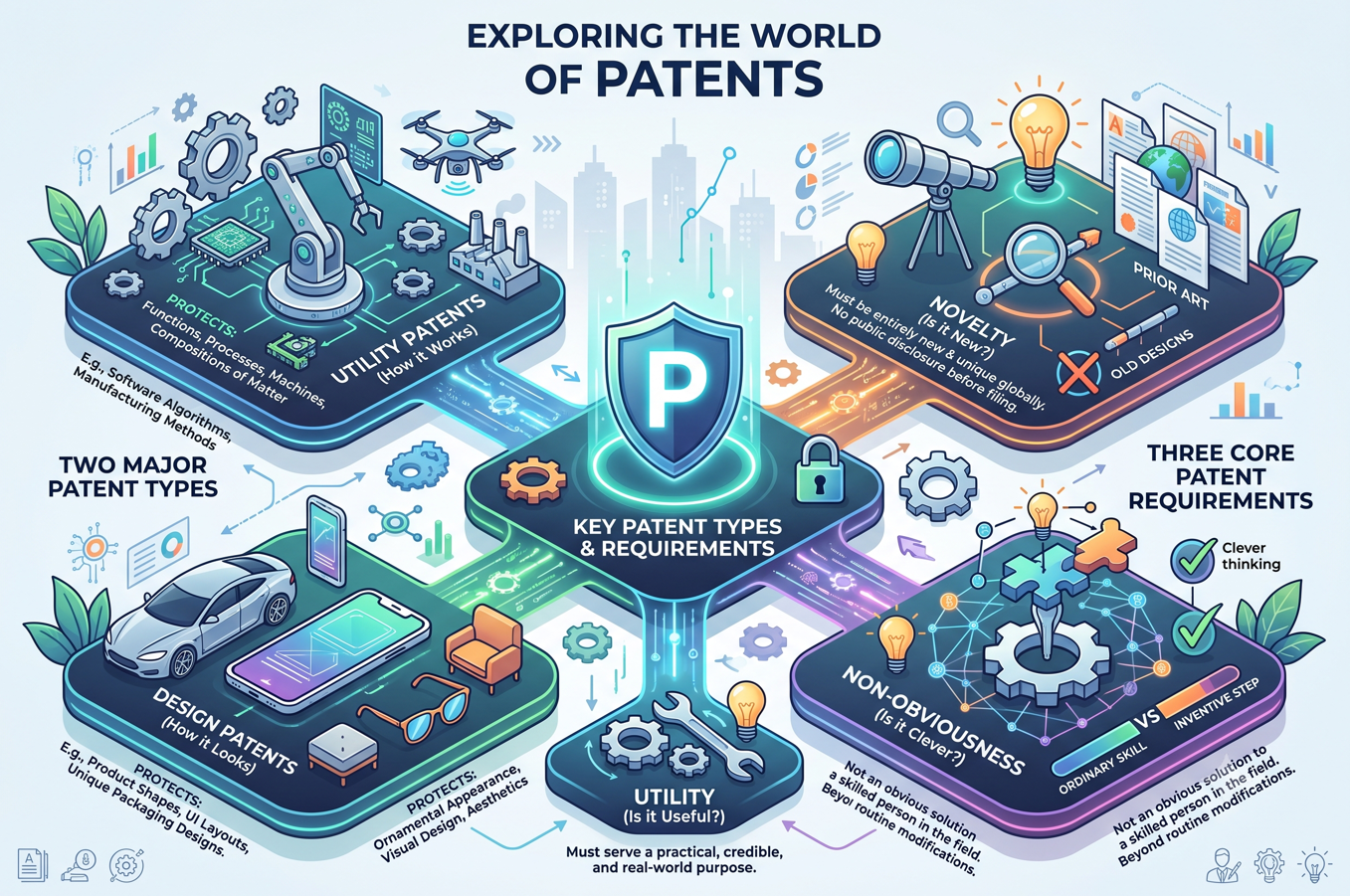
- Utility Patents: The most common variety. These protect how an invention works, including new and useful processes, machines, articles of manufacture, or compositions of matter (e.g., a novel battery chemistry, mechanical drone arm, or manufacturing method).
- Design Patents: These protect the ornamental, aesthetic design and visual characteristics of a functional item rather than how it operates (e.g., the specific contour of a smartphone case or a distinctive shoe silhouette).
- Plant Patents: Granted to anyone who invents or discovers and asexually reproduces any distinct and new variety of plant.
The 3 Core Requirements for Patentability
To qualify for a patent, your invention must meet strict legal criteria during examination:
- Novelty: The invention must be entirely new. If the technology has been publicly disclosed anywhere in the world—in academic papers, conference talks, videos, or existing products (known as “prior art”)—it fails the novelty test.
- Non-Obviousness: Even if an invention is technically new, it cannot be an obvious modification or combination of existing technologies that a person having ordinary skill in that technical field could easily deduce.
- Utility: The invention must serve a real, practical, and credible function. Abstract concepts, scientific theories, and purely artistic creations do not qualify for utility patents.
Critical Patent Strategy Tips
- Maintain Strict Confidentiality: Publicly selling, testing, or demonstrating your invention before submitting a patent application can trigger statutory bars and destroy your ability to obtain patent rights globally. Use Non-Disclosure Agreements (NDAs) until you file.
- File a Provisional Patent Application: For startups and individual inventors, filing a provisional application secures an official, early priority date at a lower upfront cost. It buys you 12 months to test market demand before committing the significant funds required for a non-provisional application.
- Patents Are Territorial: A patent granted in one country only protects you within that country’s borders. To protect your invention globally, you must file internationally using mechanisms like the Patent Cooperation Treaty (PCT).
Securing a patent transforms technical ingenuity into a defensible corporate asset, providing the market leverage required to scale, license, or attract investment safely.
