
Introduction
Creating an original work takes time, focus, and imagination. Whether you are publishing an article, writing software code, recording a podcast, or designing a digital illustration, that output carries tangible value. Understanding how copyright works ensures you retain control over your creations and can stop unauthorized use before it undermines your work.
What Is Copyright?
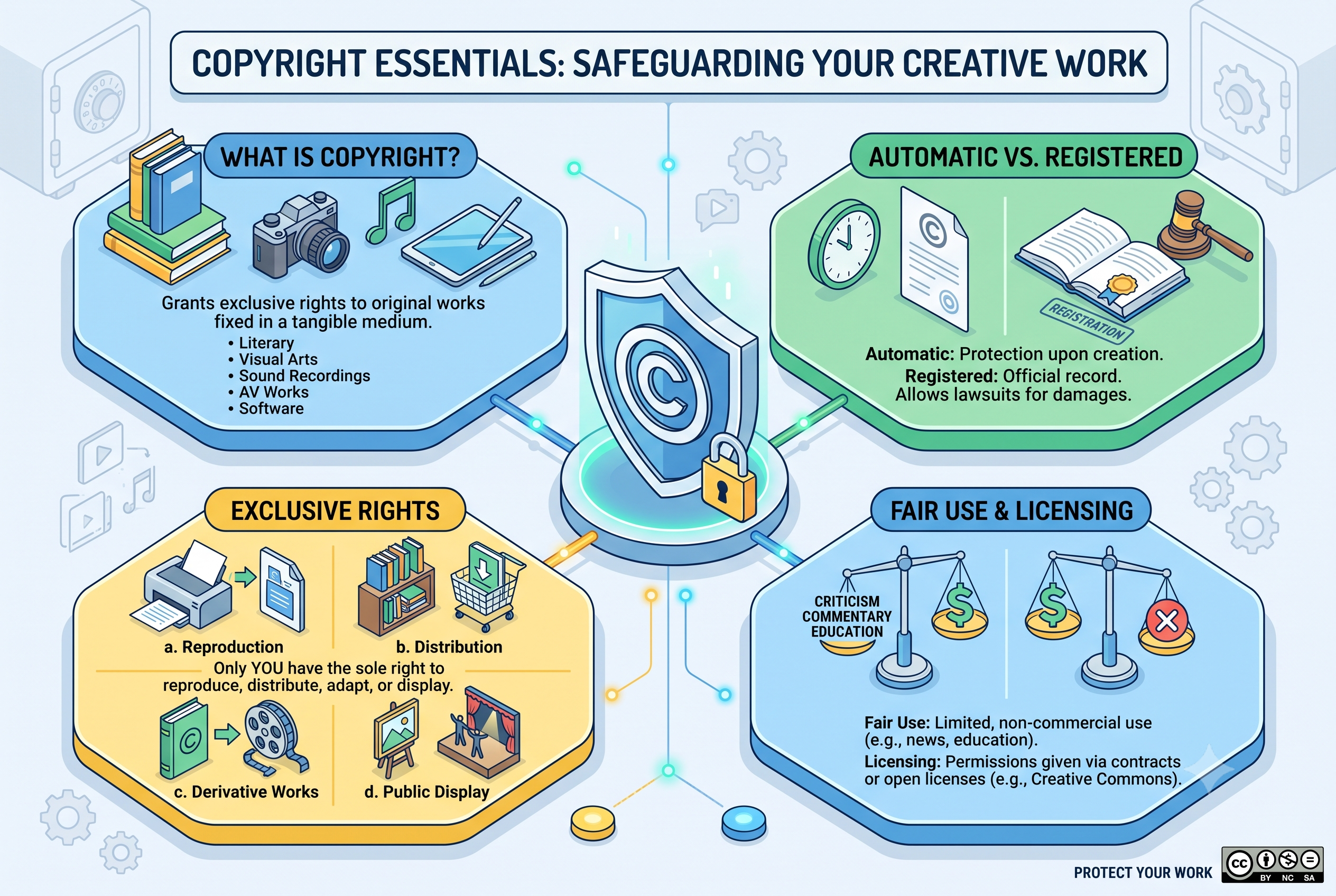
Copyright is a legal right that grants creators exclusive control over the use, distribution, and adaptation of their original creative expressions.
Unlike patents (which cover functional inventions) or trademarks (which protect brand identifiers like names and logos), copyright protects original works of authorship fixed in a tangible medium.
Key categories of protected works include:
- Literary works: Books, blog posts, essays, and computer software/code.
- Visual arts: Photographs, paintings, graphic designs, and digital illustrations.
- Audiovisual and sound recordings: Music tracks, podcasts, videos, films, and voice recordings.
- Dramatic and choreographic works: Plays, scripts, and documented dance routines.
The Idea-Expression Distinction: Copyright protects the specific expression of an idea, not the idea itself. If you write a novel about a young wizard attending boarding school, you own the text and specific character representations, but you cannot stop others from writing their own stories about magical schools.
Automatic Protection vs. Formal Registration
The moment you write down words, save a digital file, or record audio, copyright protection exists automatically. You do not need to add a symbol or pay a fee for basic protection to begin.
However, formal registration with your national copyright office (such as the U.S. Copyright Office or regional equivalents) offers distinct advantages:
- Lawsuit Eligibility: In many jurisdictions, you cannot file a copyright infringement lawsuit in court without a registered copyright.
- Statutory Damages: Timely registration often makes you eligible for statutory damages and attorney fees, eliminating the need to prove exact monetary losses.
- Public Record of Ownership: Registration provides prima facie evidence of validity, making ownership disputes far easier to win.
Exclusive Rights Granted to Owners
As the copyright holder, you have the sole legal right to:
- Reproduce and copy the work.
- Distribute copies to the public by sale, rental, or lending.
- Prepare derivative works (such as sequels, translations, or adaptations into other media).
- Publicly display or perform the work.
Others must obtain your explicit permission—usually through a license or assignment contract—to exercise any of these rights.
Understanding Fair Use and Licensing
Using portions of copyrighted material without permission is permitted only under strict exceptions, primarily fair use (or “fair dealing” in Commonwealth systems). Fair use generally applies to non-commercial commentary, news reporting, educational instruction, criticism, or parody, evaluated by the purpose of use and the impact on the work’s market value.
If you create content regularly, clearly define how others can share it. Adding a standard copyright notice (© 2026 [Your Name/Company]) or applying a clear license (such as Creative Commons for open sharing) sets boundaries early and protects your intellectual property.
